

Statue of Liberty A Global Symbol of Freedom
The Statue of Liberty is more than just a monument—she’s a powerful symbol of freedom, democracy, and hope. Located on Liberty Island in New York Harbor, this colossal statue has welcomed millions of immigrants and visitors since her unveiling. Whether you’re wondering where is the Statue of Liberty, how tall is the Statue of Liberty, or simply intrigued by Lady Liberty’s history, this guide offers a deep dive into the iconic landmark.
In this comprehensive article, we explore the statue’s origin, meaning, and influence while naturally integrating high-search keywords such as “America Statue of Liberty,” “Statue of Liberty height,” “Lady Liberty,” and more.
Where Is the Statue of Liberty?
Each year, millions of people type into search engines: “Where is the Statue of Liberty?”—and the answer, while seemingly simple, is rooted in rich geography, history, and national symbolism.
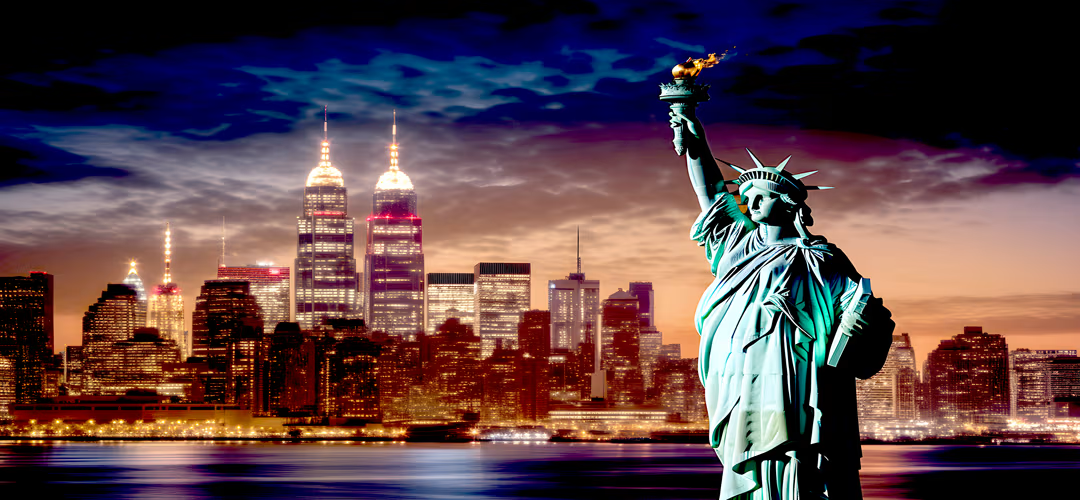
The Statue of Liberty is located on Liberty Island in the New York Harbor, just off the southern tip of Manhattan, New York City. Formerly known as Bedloe’s Island, it was renamed Liberty Island by a congressional act in 1956 to honor its most iconic resident. The statue stands at the convergence of the Hudson River and Upper New York Bay, facing southeast to greet ships arriving from the Atlantic Ocean—especially immigrants arriving at nearby Ellis Island, once the gateway for over 12 million newcomers to America.
Statue of Liberty's Precise Coordinates
The statue’s location is geographically pinpointed at:
- Latitude: 40.6892° N
- Longitude: 74.0445° W
These coordinates place Lady Liberty at a vantage point that provides sweeping views of the Manhattan skyline, Brooklyn Bridge, and New Jersey shoreline, making it one of the most photographed spots in the world.
How to Visit the Statue of Liberty?
Visiting Liberty Island is only possible via Statue City Cruises, the official ferry provider authorized by the National Park Service. Ferries operate year-round from two primary embarkation points:
- Battery Park, Manhattan (New York City)
- Liberty State Park, Jersey City (New Jersey)
These ferries not only provide safe passage but also offer stunning photo opportunities of the skyline and nearby Ellis Island. The Statue of Liberty and Ellis Island are both part of the Statue of Liberty National Monument, which is managed by the U.S. National Park Service.
Annual Visitors and Global Appeal
According to the National Park Service (NPS), the Statue of Liberty welcomes more than 4 million visitors annually, making it one of the top-visited cultural landmarks in the United States. The monument draws tourists, historians, school groups, and immigrants’ descendants who seek to connect with America’s founding ideals of freedom, democracy, and hope.
In addition to its role as a powerful historical symbol, Liberty Island offers a full visitor experience, including:
- The Statue of Liberty Museum, opened in 2019
- Access to the pedestal and, by special reservation, the crown
Educational exhibits, historical timelines, and immersive multimedia
Why Liberty Island?
The statue’s location wasn’t randomly chosen. The French sculptor Frédéric Auguste Bartholdi originally envisioned the statue facing southeast, so it would serve as a beacon of liberty to ships arriving in America—a promise to immigrants approaching Ellis Island and beyond. Its placement in the New York Harbor—the nation’s busiest immigration port in the 19th and early 20th centuries—cemented its symbolism as the “Mother of Exiles”, immortalized in Emma Lazarus’s poem The New Colossus.
How Tall Is the Statue of Liberty?
One of the most frequently asked questions by visitors and curious minds alike is:
“How tall is the Statue of Liberty?” or “What is the height of the Statue of Liberty from base to torch?”
The answer lies not just in numbers—but in symbolism, history, and groundbreaking 19th-century engineering. Her towering height was intentionally designed to inspire awe, visibility, and welcome, especially to immigrants arriving by ship to Ellis Island, once America’s busiest immigration inspection station.
Breakdown of Dimensions
The Statue of Liberty’s height is best understood by dividing it into three structural components:
|
Component |
Height |
|
Statue (from heel to top of torch) |
151 feet (46 meters) |
|
Pedestal |
154 feet (47 meters) |
|
Total Height (Base to Torch) |
305 feet (93 meters) |
Key Measurements (According to National Park Service):
- Head size: 17 feet tall (5.2 meters)
- Nose length: 4.5 feet (1.4 meters)
- Right arm length: 42 feet (12.8 meters)
- Index finger: 8 feet long (2.4 meters)
- Torch length: 29 feet (8.8 meters)
- Waist: 35 feet (10.6 meters) in circumference
- Sandaled feet: Each is 25 feet long (7.6 meters)
The crown, adorned with 7 rays, symbolizes the seven continents and seas. Each ray measures approximately 9 feet (2.7 meters) long and weighs around 150 pounds (68 kg).
Why Was the Statue Built So Tall?
When construction began in the 1870s and 1880s, the Statue of Liberty’s height was a marvel of modern engineering. Upon completion in 1886, she became one of the tallest structures in the United States. Her impressive stature was a result of both artistic ambition and practical intention:
- Visibility: Standing 305 feet above ground level, she is visible from more than 25 miles away, serving as a navigational landmark for ships entering New York Harbor.
- Symbolism: Her height represents the grandeur of liberty and democracy, and the towering presence of a nation rising as a global power.
- Immigration Beacon: Located near Ellis Island, the Statue’s height and elevated torch became an enduring image of hope, freedom, and a new beginning for millions of immigrants arriving in the late 19th and early 20th centuries.
Engineering Feat of the Era
French sculptor Frédéric Auguste Bartholdi envisioned Liberty as a colossal woman rising above the sea. To achieve this, the iron framework was designed by none other than Gustave Eiffel, the engineer behind the Eiffel Tower.
Her internal structure—a mix of copper sheets over a wrought iron skeleton—was unprecedented. Eiffel’s expertise allowed for expansion and contraction with temperature changes, enabling the statue to withstand strong winds and coastal weather. At the time, Liberty was the tallest iron structure ever built, long before skyscrapers dominated American cities.
Modern Comparison
To put her size in perspective:
- The Statue of Liberty is taller than the Leaning Tower of Pisa (about 185 feet).
- It stands slightly taller than the Big Ben tower in London (316 feet vs. 305 feet, including base).
- If Lady Liberty were laid down horizontally, she would be almost as long as a football field.
When Was the Statue of Liberty Built?
If you’ve ever wondered, “When was the Statue of Liberty built?”, the answer goes far beyond her iconic unveiling in 1886. The story of this world-famous monument is a powerful tale of transatlantic collaboration, shared ideals, and engineering ingenuity that spanned over two decades.
The Idea is Born: 1865
The origins of the Statue of Liberty trace back to 1865, right after the end of the American Civil War. French jurist, abolitionist, and political thinker Édouard René de Laboulaye proposed the idea of a monument that would honor:
- The centennial of American independence (1776–1876)
- The shared values of liberty and democracy between France and the United States
- France’s admiration for the American experiment in self-governance
Laboulaye famously remarked that if a monument were to be built in the U.S. as a tribute to liberty, “it should be a joint project of the two nations.”
Design & Construction Timeline
Here is a chronological timeline of the key events that brought the Statue of Liberty to life:
| Year | Event |
| 1865 | Idea proposed by Laboulaye in France |
| 1870 | French sculptor Frédéric Auguste Bartholdi begins initial designs |
| 1875 | Official fundraising starts in France; the project is named “Liberty Enlightening the World” |
| 1881–1884 | Full statue constructed in Paris using copper sheets over an iron skeleton by Gustave Eiffel |
| July 4, 1884 | Statue completed in France and formally presented to U.S. Ambassador Levi Morton |
| June 17, 1885 | Arrives in New York Harbor in 350 individual pieces packed into 214 crates aboard the French ship Isère |
| 1885–1886 | Pedestal construction completed on Liberty Island (then Bedloe’s Island) by Richard Morris Hunt, funded largely by donations from American citizens through a campaign led by Joseph Pulitzer |
| October 28, 1886 | Official dedication by U.S. President Grover Cleveland during a grand ceremony in New York City |
Who Built the Statue of Liberty?
The creation of the Statue of Liberty was a monumental international collaboration that brought together some of the most brilliant minds from France and the United States. Far from being the product of a single individual, it represented a collective vision and unified effort to celebrate liberty, democracy, and international friendship.
Frédéric Auguste Bartholdi – The Artistic Visionary Behind the Statue of Liberty
At the heart of the project stood French sculptor Frédéric Auguste Bartholdi (1834–1904), a master of monumental art. Inspired by classical Roman goddesses such as Libertas, he envisioned a towering figure to represent liberty enlightening the world. On his visit to the United States in 1871, Bartholdi selected Bedloe’s Island (now Liberty Island) in New York Harbor as the ideal location for the statue. Its strategic position would ensure that it was the first symbol seen by immigrants arriving by sea, emphasizing its message of welcome and hope. Beyond his artistic vision, Bartholdi was also instrumental in public outreach and fundraising.

He worked tirelessly in both France and America to secure financial and political backing, ensuring the statue’s completion despite multiple setbacks.
Gustave Eiffel – Engineering the Internal Structure of the Statue of Liberty
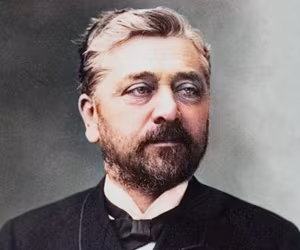
While Bartholdi designed the exterior, the internal framework of the Statue of Liberty was the genius of Gustave Eiffel (1832–1923), the celebrated engineer behind the Eiffel Tower. Tasked with making the colossal copper statue structurally sound, Eiffel introduced groundbreaking engineering techniques that made it resilient against strong winds and natural expansion due to temperature changes.
His design featured a central iron pylon supporting a flexible skeletal system, allowing the copper skin to move slightly with the wind without cracking. This innovation not only made Lady Liberty durable but also laid the foundation for future advancements in skyscraper construction.
Eugène Viollet-le-Duc – The Early Engineer of the Statue of Liberty
Before Gustave Eiffel became synonymous with the Statue of Liberty’s engineering brilliance, the project was initially entrusted to the esteemed French architect and theorist Eugène Viollet-le-Duc (1814–1879). Celebrated for his meticulous restorations of Gothic architectural masterpieces, including the famed Notre-Dame Cathedral in Paris, Viollet-le-Duc brought with him a visionary yet historically rooted design philosophy. He was tasked with designing the internal structural system that would support Frédéric Auguste Bartholdi’s ambitious sculpture.
Viollet-le-Duc proposed a technique involving a central masonry pier filled with sand, upon which the copper sheets of the statue would be mounted. His plan was aesthetically aligned with classical statuary traditions but ultimately proved technically unfeasible, especially given the statue’s unprecedented scale and the need for flexibility against wind and environmental pressures.
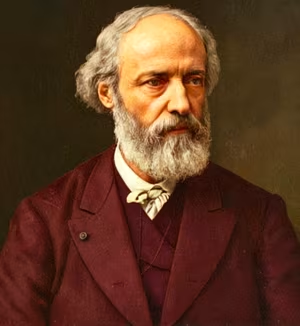
Tragically, Viollet-le-Duc passed away before his structural design could be fully developed or tested. His death marked a turning point in the project, prompting Bartholdi to seek out Gustave Eiffel, whose expertise in modern iron frameworks would revolutionize the statue’s internal engineering. Eiffel’s more dynamic and innovative approach—using a flexible iron skeleton with secondary armature bars to support the copper skin—replaced Viollet-le-Duc’s rigid and outdated concept. Yet, Viollet-le-Duc’s early involvement remains a critical chapter in the story of how one of the world’s most iconic monuments came to be.
Richard Morris Hunt – Designing the Pedestal of the Statue of Liberty
Renowned American architect Richard Morris Hunt (1827–1895) was responsible for designing the statue’s granite pedestal. A pioneer in American architecture and the first U.S. citizen to study at the École des Beaux-Arts in Paris, Hunt’s neoclassical design harmonized with Bartholdi’s Roman-inspired statue.
Standing at 89 feet (27 meters) tall, the pedestal was constructed from granite quarried in Leete’s Island, Connecticut. Inside, it houses a museum that provides historical context about the statue’s creation and meaning. Hunt’s pedestal not only elevated the statue physically but also symbolized the strong partnership between France and the United States.

Why Was the Statue of Liberty Built?
The Statue of Liberty was conceived as more than just an artistic monument; it was a powerful political symbol. Proposed by Édouard de Laboulaye, a French political thinker and abolitionist, the statue was intended to honor the enduring friendship between France and the United States and to commemorate shared values of liberty and democracy. At a time when France was recovering from internal political strife, the statue also served as a beacon of republican ideals.
Although the goal was to unveil the statue in 1876 to mark the U.S. Centennial, delays in funding and construction pushed the completion to 1886. On October 28 of that year, more than a million people gathered in New York City for the grand dedication ceremony. The event included a parade, emotional speeches, and the first-ever ticker-tape celebration along Wall Street.
Who Funded the Statue of Liberty?
While France financed the statue itself, the United States was responsible for funding the pedestal—a task that proved difficult. The American government struggled to raise the necessary money, prompting Joseph Pulitzer, a Hungarian-born newspaper publisher, to step in. Through his newspaper New York World, he launched a nationwide fundraising campaign that appealed directly to ordinary Americans.
In a remarkable display of public support, more than 120,000 people donated—many contributing less than a dollar. This grassroots initiative is now recognized as one of the earliest examples of crowdfunding, and it reinforced the idea that the statue was truly a gift from the people, for the people.
How the Statue of Liberty Was Built: Engineering Marvels and Global Effort
The construction of the Statue of Liberty was a remarkable feat of 19th-century engineering. Bartholdi crafted the outer skin using a technique called repoussé, where copper sheets only 3/32 inch thick (2.5 mm) were hammered into shape. These sheets were affixed to Eiffel’s flexible iron framework using metal armatures that allowed them to sway slightly in the wind—an essential feature for a structure of this scale standing in a coastal environment.
The statue was assembled in Paris in 1884 to ensure all parts fit together perfectly. Then it was disassembled into 214 crates and shipped across the Atlantic to New York in 1885. Over the course of four months in 1886, it was reassembled on Liberty Island.
The Statue of Liberty as a Symbol of Global Collaboration
Although Bartholdi is most often credited for the Statue of Liberty, the monument is the product of extraordinary teamwork. French artistic ingenuity combined with American engineering expertise and the will of ordinary citizens to create one of the most enduring emblems of freedom.
The contributions of Bartholdi, Eiffel, Hunt, and Pulitzer—and the enthusiasm of the general public—transformed the statue into an international symbol. It represents the power of shared values and the incredible results that can be achieved through cross-cultural cooperation and public engagement.
The Lady Liberty History: More Than Just a Statue
While millions recognize her silhouette, few fully grasp the deep historical roots and symbolism behind Lady Liberty, officially named “Liberty Enlightening the World.” Far more than a statue, she is a profound representation of universal ideals—freedom, enlightenment, democracy, and hope.
Her story begins not in New York Harbor, but in France, during a period of political unrest and reform. Conceived in the mid-19th century, Lady Liberty reflects the aspirations of two nations—the United States and France—bound by revolutionary history and the pursuit of liberty.
Born from Political Idealism
In the aftermath of the American Civil War and amid growing authoritarianism in France under Napoleon III, French jurist and abolitionist Édouard René de Laboulaye proposed a grand idea: to build a monument in America celebrating both the centennial of U.S. independence (1776) and the shared democratic ideals of the two republics.
Laboulaye and his protégé, Frédéric Auguste Bartholdi, envisioned a statue that would:
- Honor the fight for freedom and democracy
- Symbolize the abolition of slavery
- Reflect a transatlantic alliance between democratic nations
Thus, Lady Liberty’s foundation lies in ideology and diplomacy, not just art and engineering.
Symbols Incorporated in the Statue's Design
Every inch of the Statue of Liberty is laced with allegorical meaning, crafted with thoughtful intent by Bartholdi.
|
Symbol |
Meaning |
|
Torch |
Represents enlightenment, the light of liberty guiding the world away from oppression and ignorance. It is not merely a flame but a beacon of intellectual and moral clarity. |
|
Tablet |
Held in her left hand, it bears the date July 4, 1776 in Roman numerals (JULY IV MDCCLXXVI), marking the Declaration of Independence and America’s birth as a free nation. |
|
Broken Chains and Shackles |
Located at her feet, the chains signify freedom from tyranny, slavery, and oppression. This subtle yet powerful symbol connects the statue to the abolitionist movements of both the U.S. and France. |
|
Seven Rays on Her Crown |
These represent the seven continents and seven seas, expressing the universal nature of liberty. The crown itself suggests nobility and light. |
|
Robe and Pose |
Modeled after Libertas, the ancient Roman goddess of liberty, her flowing robe and upright posture embody dignity, strength, and resolve. |
The Statue of Liberty National Monument
While the Statue of Liberty stands tall as a beacon of freedom and democracy, she is also protected and honored as a national treasure. Recognizing her cultural, historic, and symbolic significance, the U.S. government took official steps to ensure her preservation for future generations by designating her as a National Monument.
Designation as a National Monument (1924)
On October 15, 1924, President Calvin Coolidge used his authority under the Antiquities Act of 1906 to proclaim the Statue of Liberty a National Monument. This act recognized her not merely as a tourist attraction, but as a monument of national and international importance.
- This designation gave the Statue federal protection under the S. Department of the Interior, particularly through the National Park Service (NPS).
- It ensured resources and oversight for preservation, education, and maintenance.
In 1965, President Lyndon B. Johnson expanded the National Monument boundaries to include nearby Ellis Island, further enriching the site’s historical narrative by linking the Statue with the immigration story of the United States.
Managed by the National Park Service
Today, the Statue of Liberty National Monument is managed by the National Park Service, a division of the U.S. Department of the Interior. Their responsibilities include:
- Preservation of the physical structure and its internal components
- Educational programming for millions of visitors annually
- Security and safety of the site, staff, and visitors
- Archaeological conservation of Ellis Island and Liberty Island
The NPS also oversees public access to the pedestal, museum, and—by reservation—the statue’s crown, a bucket-list experience for many travelers.
Restoration for the Centennial (1986)
By the early 1980s, after nearly a century of exposure to harsh maritime weather, salt air, and pollution, the Statue of Liberty was showing signs of serious wear and corrosion. In anticipation of her 100th anniversary in 1986, a massive restoration project was undertaken.
Key highlights of the 1984–1986 centennial restoration include:
- Replacing the original torch (which had been modified in 1916) with a new copper-and-glass replica, while preserving the original torch for museum display
- Reinforcing the iron framework and replacing rusted supports
- Restoring Bartholdi’s intricate repoussé copperwork
- Cleaning, sealing, and weatherproofing both the interior and exterior
- Installing modern elevators, lighting, and visitor amenities
The project cost approximately $100 million, funded by public-private partnerships, including significant donations from American citizens and corporations under the Statue of Liberty-Ellis Island Foundation.
The restoration culminated in a centennial celebration on July 4, 1986, presided over by President Ronald Reagan, with international fanfare and a massive fireworks display over New York Harbor.
The Statue of Liberty Museum (2019)
In May 2019, the Statue of Liberty Museum was officially opened on Liberty Island to enhance the visitor experience and protect the statue’s symbolic artifacts. The museum features:
- A full-scale replica of the statue’s face, allowing visitors to experience her scale and craftsmanship up close
- The original torch, preserved behind glass as a central exhibit
- Immersive multimedia galleries exploring:
- The statue’s symbolism
- The engineering and construction process
- The stories of immigrants and liberty-seekers
Built with sustainable architecture and designed to withstand rising sea levels, the museum integrates modern technology with historic reverence.
Ongoing Maintenance and Preservation
Preserving a 305-foot monument exposed to coastal elements requires constant vigilance. Maintenance is conducted regularly to address:
- Corrosion and rust in the iron and copper structures
- Structural integrity after storms, seismic activity, and seasonal shifts
- Visitor infrastructure, including elevators, safety rails, and climate control systems
- Monitoring and preserving the museum’s exhibits and original materials
These efforts are guided by preservation science, using non-invasive technologies to inspect the internal framework and surface without damaging the original materials.
A Living Monument
The Statue of Liberty National Monument is more than a preserved structure—it’s a living symbol of freedom, equality, and human dignity. It welcomes over 4 million visitors annually from around the world and continues to evolve through:
- Educational initiatives
- Cultural events
- International diplomacy
- Environmental sustainability efforts
Its stewardship by the National Park Service ensures that Lady Liberty remains a vibrant part of America’s national identity and global message.
Ellis Island and Lady Liberty
The proximity of the Statue of Liberty to Ellis Island made the two inseparable symbols of immigration. Ellis Island, often referred to as the “Gateway to America,” processed millions of new arrivals, many of whom passed directly under the gaze of Lady Liberty.
- For Europeans fleeing war, famine, and political upheaval, the statue embodied the promise of safety and freedom.
- For immigrants escaping religious or ethnic persecution, she was a guardian of rights and equality.
- For all, she was a sign of arrival, a moment when dreams began to feel real.
The Statue’s Role in Immigration History
Lady Liberty’s association with immigration is deeply rooted in the late 19th and early 20th centuries, during America’s peak immigration period (1880–1920). During this era:
- More than 20 million immigrants arrived in the U.S., many from Italy, Ireland, Russia, Poland, and Germany.
- The Statue of Liberty stood as a universal symbol of welcome in an unfamiliar land.
- Her torchlight became a metaphorical guide—the “lamp beside the golden door,” as Lazarus wrote.
Even today, the statue is frequently invoked as a symbol of America’s immigrant heritage, reflecting the nation’s identity as a melting pot of cultures and communities.
Fun & Lesser-Known Facts about the Statue of Liberty
The Statue of Liberty’s iconic green hue is the result of a natural weathering process. Originally constructed from thin copper sheets, Lady Liberty first gleamed a bright copper-orange, much like a newly minted penny. Over time, exposure to the elements caused the copper to oxidize, resulting in the distinctive patina that now defines her appearance.
Structurally, the statue is an impressive feat of 19th-century engineering. Lady Liberty weighs over 450,000 pounds, or approximately 225 tons. Despite her immense weight, she was designed with flexibility in mind. The statue can sway up to three inches in winds reaching 50 miles per hour, while the torch—extending higher—can move as much as five inches. This resilience speaks to the foresight of her designers, including Gustave Eiffel, who engineered her internal framework.
For those wishing to experience the monument from a truly unique perspective, access to the crown is available by reservation only. Reaching the crown requires climbing a narrow, spiral staircase of 354 steps, and only 240 visitors are allowed to ascend per day. There is no elevator access, making the journey a physical challenge but a rewarding one for those who reach the top.
An important element of the statue’s transformation over time is her original torch, which suffered extensive corrosion. During the centennial restoration in the mid-1980s, the torch was replaced with a new one, carefully modeled to preserve the original aesthetic. The original torch now resides in the Statue of Liberty Museum, where it continues to inspire and educate millions of visitors.
🗽 NYC and Statue of Liberty Tourism Highlights
For anyone searching “New York City and Statue of Liberty,” planning your visit begins with understanding the must-see attractions and key logistics. The Statue of Liberty is more than a monument—it is a full experience that blends history, culture, and breathtaking views.
Liberty Island is the heart of the experience. Home to the Statue of Liberty, it also features the informative Statue of Liberty Museum, scenic walking paths, and a well-stocked gift shop. Just across the water, Ellis Island Immigration Museum offers a powerful and emotional journey through the history of American immigration, highlighting the hopes, struggles, and stories of millions who entered the United States through this gateway.
Visitors typically begin their journey from Battery Park in Lower Manhattan, the primary ferry departure point. Alternatively, Liberty State Park in New Jersey provides another excellent entry with the added benefits of shorter wait times and panoramic views of the Manhattan skyline—an ideal option for avoiding peak crowds.
To make the most of your visit, it’s essential to plan ahead. Purchasing ferry tickets in advance is highly recommended, particularly if you intend to access the statue’s pedestal or crown, as these reservations often sell out weeks in advance. Arriving early—ideally 30 to 45 minutes before your scheduled security check—helps avoid delays and gives you more time to explore both islands.
Time management is key. While a full visit to Liberty Island and Ellis Island can take three to four hours, those on a tighter schedule can complete the tour in two to three hours with a brisk pace. Regardless of your itinerary, dressing appropriately is crucial. Wear comfortable walking shoes, bring sun protection and water, and be prepared for strong winds and exposed conditions, especially near the waterfront. With smart planning, your visit to this iconic American landmark will be both memorable and enriching.
Civic and Educational Significance of the Statue of Liberty
Far more than a tourist attraction, the Statue of Liberty serves as a powerful educational resource and symbol of civic identity. It provides a platform for teaching foundational values such as freedom, democracy, and the historical immigration experience in the United States. Through its French origins and neoclassical design, the monument also highlights Franco-American relations and offers insight into the use of symbolism in public art and architecture.
Educational institutions at all levels—from elementary schools to universities—incorporate the Statue of Liberty into their curricula. Whether as part of a field trip to Liberty Island or through classroom lessons and virtual resources, the statue is regularly used to explore the themes of American identity, political evolution, and the immigrant journey. It stands not only as a tribute to history but also as an active participant in shaping the civic consciousness of future generations.
Summary: 7 Iconic Truths about the Statue of Liberty
The Statue of Liberty Was a Gift from France
She was given to the United States in 1886 as a symbol of friendship and shared democratic values between France and America.
Her Real Name Is Not ‘Lady Liberty’
The statue’s official name is Liberty Enlightening the World, though she’s lovingly called Lady Liberty by millions.
She’s Taller Than You Think
The Statue of Liberty height is 305 feet (93 meters) from the base to the torch, making her taller than most 20-story buildings.
She Was Assembled Like a Giant Puzzle
The statue arrived in America in 350 pieces packed in over 200 crates and took four months to assemble on Liberty Island.
Her Torch and Crown Are Full of Symbolism
The torch represents enlightenment, and her crown has seven spikes, symbolizing the seven continents and seas.
She Welcomed Millions of Immigrants
Located near Ellis Island, she was the first sight of America for millions of immigrants searching for a better life.
She’s a National Monument and UNESCO Heritage Site
Designated as a Statue of Liberty National Monument in 1924 and later protected under UNESCO, she’s globally recognized for her cultural and historical importance.
Conclusion: Why the Statue of Liberty Still Matters in the Modern World
In a time defined by rapid global transformation, political polarization, and evolving definitions of identity and freedom, the Statue of Liberty continues to hold profound relevance. More than just a towering landmark on Liberty Island, she remains a beacon of hope, resilience, and shared human ideals. Her outstretched torch and steadfast stance symbolize a promise that transcends generations—a promise of liberty, opportunity, and inclusion for all who seek a better life.
The core values she embodies—freedom, democracy, justice, and compassion—are not relics of the past, but rather guiding principles for the present and future. In times of uncertainty, Lady Liberty offers a sense of grounding. Her silent yet powerful presence reminds Americans and the global community alike of the enduring spirit of unity, human dignity, and the courage to embrace diversity.
Whether you’re drawn to her monumental architecture, curious about who made the Statue of Liberty, or wondering when the Statue of Liberty was built, one truth remains: She is not just a statue—she is a symbol that speaks to the heart of the American dream.
Lady Liberty continues to inspire millions—not only as a historical monument, but as a living emblem of what society can achieve when it values inclusion over exclusion, freedom over fear, and hope over division. As long as she stands in New York Harbor, the Statue of Liberty will remain a timeless call to remember, reflect, and strive for a better tomorrow.
📚 References
- Eiffel, G. (1886). Correspondence on Structural Design for Liberty Enlightening the World. French Engineering Archives.
- Eiffel, G. (1886). Design Plans for the Liberty Statue Framework. Paris Civil Engineering Archives.
- Ellis Island Foundation. (n.d.). Immigration Records and Stories.
- Harris, C. (2004). Liberty: The Statue and the American Dream. Skyhorse Publishing.
- Khan Academy. (n.d.). The Statue of Liberty.
- Lazarus, E. (1883). The New Colossus. In Poems of Emma Lazarus. Houghton Mifflin.
- Library of Congress. (n.d.). Statue of Liberty: The Making of an Icon.
- Miller, J. (2000). The Statue of Liberty: A Transatlantic Story. Yale University Press.
- National Park Service. (n.d.). History of the Statue of Liberty. U.S. Department of the Interior.
- National Park Service. (n.d.). Statue of Liberty. U.S. Department of the Interior.
- National Park Service. (n.d.). Statue of Liberty and Ellis Island Immigration History. U.S. Department of the Interior.
- National Park Service. (n.d.). Statue of Liberty Height and Dimensions. U.S. Department of the Interior.
- National Park Service. (n.d.). Statue of Liberty National Monument. U.S. Department of the Interior.
- National Park Service. (n.d.). Statue of Liberty National Monument History & Culture. U.S. Department of the Interior.
- National Park Service. (n.d.). Who Built the Statue of Liberty?. U.S. Department of the Interior.
- New York Historical Society. (2016). Collaborators in Liberty: The Builders Behind the Monument.
- New York Historical Society. (2016). The Making of Liberty.
- Pulitzer, J. (1885). Fundraising for the Pedestal. New York World Archives.
- Reagan, R. (1986, July 4). Remarks at the Centennial Celebration of the Statue of Liberty. The American Presidency Project.
- Smithsonian Institution. (2017). Mother of Exiles: How the Statue of Liberty Became a Symbol of Immigration.
- Smithsonian Institution. (2019). The Statue of Liberty Museum: A New Chapter in Preservation.
- Smithsonian Institution. (n.d.). Lady Liberty: The People Behind the Icon.
- Smithsonian Magazine. (2011). Engineering a Colossus: How Gustave Eiffel Built the Statue of Liberty.
- Smithsonian Magazine. (2011). Engineering Liberty: The Genius Behind Lady Liberty.
- Smithsonian Magazine. (2011). Who Was the Real Lady Liberty?
- Statue City Cruises. (n.d.). Visit the Statue of Liberty & Ellis Island.
- Statue of Liberty-Ellis Island Foundation. (n.d.). Restoration and Museum Initiatives.
- S. Department of the Interior. (1986). Centennial Restoration Report of the Statue of Liberty. Government Printing Office.
- S. Geological Survey (USGS). (n.d.). Topographic Map: Liberty Island.
- (n.d.). Statue of Liberty.